%20(2).png)
Artificial intelligence (AI) is helping researchers identify promising drug candidates faster, reshaping how new pharmaceutical treatments move from development to clinical reality to patient delivery.
What once took years of laboratory research and validation can now happen in months, as AI-powered platforms identify promising drug candidates, analyze vast biological datasets and accelerate early-stage development.
As a result, pharmaceutical and biotechnology companies are advancing more therapies through the development pipeline than ever before. Recent breakthroughs are helping demonstrate that potential. In August 2026, Moderna and Merck announced positive late-stage trial results for a personalized mRNA cancer vaccine, a milestone researchers say could open the door to similar therapies for a range of cancers.
The impact extends far beyond the research lab. For designers, builders and facility owners, the question is no longer whether AI will reshape pharmaceutical manufacturing; it is how quickly facilities can adapt to support a faster, more dynamic development environment.
Manufacturers now face growing pressure to bring new production capacity online faster while maintaining the stringent quality and regulatory standards the industry demands. At the same time, pharmaceutical companies are investing heavily in United States manufacturing capacity, creating new opportunities for facility development and modernization.
Major organizations including Eli Lilly, Merck, AstraZeneca, Novo Nordisk, Genentech and Regeneron are increasing their United States investments amid a broader push to expand domestic pharmaceutical manufacturing.
For designers, builders and facility owners, the question is no longer whether AI will reshape pharmaceutical manufacturing; it is how quickly facilities can adapt to support a faster, more dynamic development environment.
According to Andrew Ahrendt, director, national manufacturing at PCL Construction, three trends are having the greatest impact on biopharmaceutical facilities today: speed, flexibility and digital integration.
1. Speed is the new normal
Due to increased production speed, companies increasingly need to make facility decisions while pharmaceuticals are still being evaluated, creating new urgency around planning, permitting, design and construction.
“AI isn't just accelerating the science,” says Ahrendt. “It's compressing the entire capital planning cycle. Owners who used to have years to plan a facility are now making capacity decisions in a fraction of that time.”
That pressure is driving greater interest in modular construction, prefabricated utility systems and collaborative delivery models that allow multiple project activities to advance in parallel. Site selection, permitting, utility planning and process design increasingly occur concurrently rather than sequentially, helping owners move projects forward more quickly.
2. Flexibility is becoming a core design requirement for manufacturing facilities
While AI may help identify promising therapies faster, it does not eliminate uncertainty.
Manufacturers often do not know which products will ultimately succeed in clinical trials or reach commercial scale. As a result, facilities must be designed to adapt to changing production needs over time.
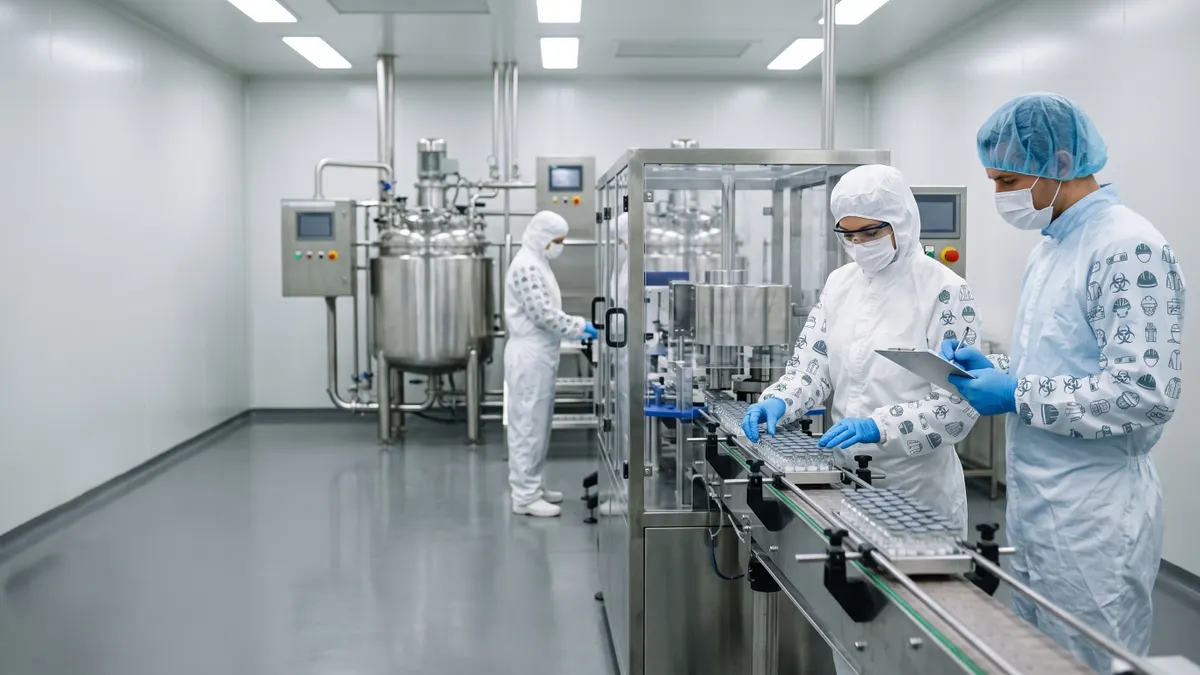
Many owners are prioritizing manufacturing environments that can accommodate multiple production strategies without extensive renovations. This includes modular scopes, expansion-ready utility infrastructure and "ballroom" manufacturing layouts, a pharmaceutical facility design approach that replaces a series of dedicated production rooms with a large, open manufacturing space where equipment can be added, removed or reconfigured as production needs change.
“We're seeing more requests for pilot plants and process development facilities,” says Ahrendt. Pilot plants allow manufacturers to test and refine production processes before moving to commercial-scale manufacturing. “Owners are also asking for multi-product, flexible spaces rather than dedicated single-product lines because they don't yet know which candidates in a larger pipeline will ultimately make it to commercial scale.”
This approach helps companies avoid investing in facilities or equipment they may not need while giving manufacturers more flexibility to respond to shifting market demand.
3. Building digital native facilities for biopharma
Technology tools that leverage AI — such as digital twins, predictive analytics and real-time data collection — are becoming increasingly important tools across the pharmaceutical industry. As manufacturers rely more heavily on these technologies to optimize processes, monitor equipment and improve operational performance, facility infrastructure must support those capabilities from the start.
That means data architecture and operational technology systems can no longer be treated as late-stage additions. Instead, digital scopes are moving earlier into the design process, influencing everything from facility layouts and utility systems to commissioning strategies and long-term asset management.
At PCL, digital twin-enabled documentation is already incorporated into project commissioning and closeout processes, helping owners begin operations with a more complete digital record of their facilities.
“Digital-native strategies are being deployed on all new facilities,” Ahrendt says. “Digital twins aren't a nice-to-have anymore. Clients are depending on a data-rich handoff earlier and earlier in the project lifecycle and design construction partners need to be ready to deliver it.”
Keeping pace with innovation
Pharmaceutical manufacturers are expanding capacity, investing in digital technologies and rethinking how facilities are planned and operated.
The challenge now is ensuring facility development can keep pace with innovation.
“AI is compressing the science timeline,” says Ahrendt. “The physical realities of construction, commissioning, qualification and validation don't compress at the same rate. The organizations that succeed will be the ones that build flexibility and coordination into projects from the beginning rather than trying to catch up later.”