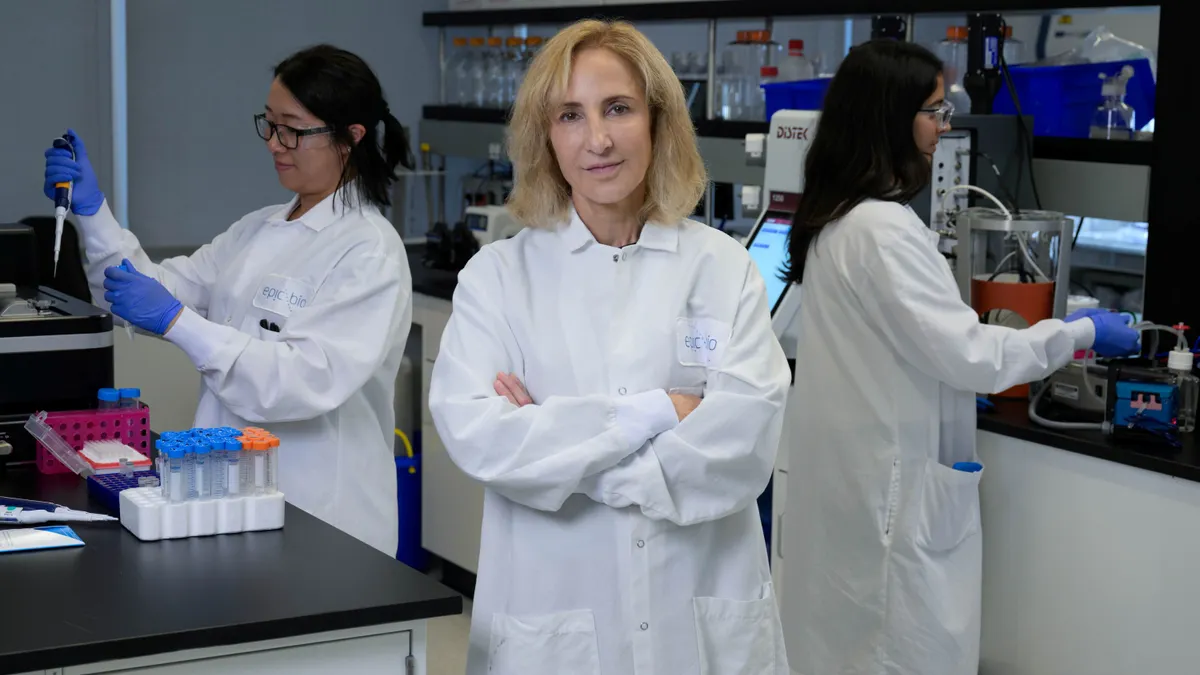
Epicrispr Biotechnologies has raised another $90 million to accelerate development of a first-of-its-kind treatment for a rare genetic muscle disorder.
That treatment, EPI-321, harnesses what’s known as “epigenetic editing,” an emerging form of genetic medicine that uses CRISPR tools to switch genes on or off rather than alter DNA. With EPI-321, Epicrispr is using this strategy to silence the genetic driver of facioscapulohumeral muscular dystrophy, or FSHD, a progressive neuromuscular condition. The company has completed enrollment in an early-stage study.
The Series C round announced Tuesday “marks a pivotal milestone for Epicrispr as we advance EPI-321 and the next generation of programmable epigenetic medicines,” said CEO Amber Salzman, in a statement.
Epigenetic editing has captured the attention of researchers, companies and investors alike because of its potential to subtly dial up or down gene expression without breaking or rewriting DNA. Proponents believe that technique might be less risky than DNA editing approaches and help genetic medicine reach a wider range of diseases.
In FSHD, for instance, the overexpression of a gene called DUX4 causes muscle atrophy and degeneration. Rather than cut into that gene, EPI-321 binds to a specific area of DUX4 and makes a chemical modification that suppresses production of its encoded protein. The hope is that effect will stop the death of muscle cells and improve function. Early clinical data have shown the potential to boost muscle volume and impact biological markers associated with DUX4 suppression.
“While these are still early data from a small number of patients, they provide important initial evidence supporting EPI-321’s potential to address the underlying biology of FSHD,” Salzman wrote in an email to BioPharma Dive.
Results with six months of study follow-up should come in early October, she said.
Multiple other drugmakers have zeroed in on FSHD, many of which aim to block DUX4 in one way or another. Prospective treatments from Novartis, Arrowhead Pharmaceuticals, Dyne Therapeutics and Sarepta Therapeutics, among others, are in human testing.
Epicrispr has raised $213 million since its inception. Octagon Capital and Janus Henderson Investors co-led the latest financing, which included more than half a dozen other backers, among them Fidelity Management & Research, Sanofi Ventures and Cormorant Asset Management. Anran Li, an investment analyst at Octagon Capital, will join the startup’s board of directors.
The new financing gives Epicrispr “the resources and flexibility” to advance EPI-321, invest in its pipeline and “build the company for the long term,” Salzman said.